Work/UX/UI/№02
UX/UI
Grundfos
Multi-market localization challange
Designed and created a 32-language localization workflow with an automated, governance-driven system that keeps industrial UI intact across markets.
- Role
- Lead UX Architect
- Year
- 2024 – 2026
- Team
- Product specialists · Software Engineering · Localization
- Stack
- Figma · Phrase
Problem
As Grundfos was ready to launch it's newest product, it expanded it's available languages. Managing software localization across 32 languages created unsustainable operational overhead. The lack of a centralized system for keys led to inconsistent industrial terminology and duplicate text blocks across different modules.
Text updates were applied inconsistently, causing critical visual breakage when general text strings conflicted with feature-specific contexts, and failing to account for language-specific character counts.
Approach
The solution involved migrating the entire localization workflow to Phrase, creating an automated data pipeline that decoupled copy strings from the hard-coded UI architecture. By replacing static excel sheets with a dynamic repository and a centralized string repository, the system ensured that core technical data and UI components adapt fluidly to multi-market updates without manual design interventions.
01
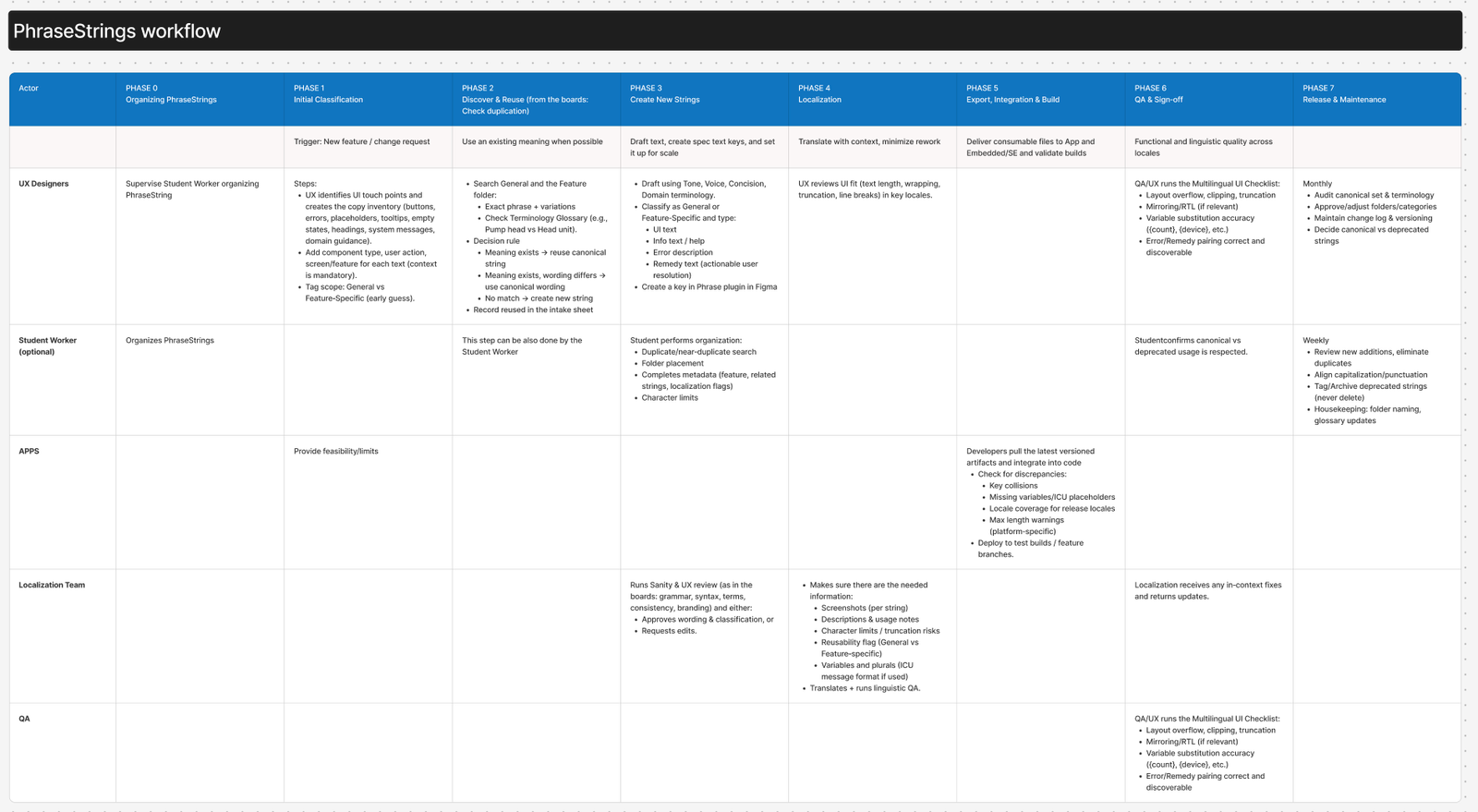
Multi-actor process mapping
I created a a comprehensive, cross-functional flowchart mapping the exact sequence of actions across Design, Global Product Marketing, Local Translators, and Software Engineering. Identified handoff bottlenecks and established clear boundaries for when a string is defined, open for translation, and locked for deployment.
02
Content architecture & string de-duplication
I audited the global product suite to eliminate duplicate phrase strings, collapsing redundant variations into a single standardized asset library. Separated general system text from feature-specific engineering copy so global updates never inadvertently altered precise technical interfaces.
03
Cross-functional engineering alignment
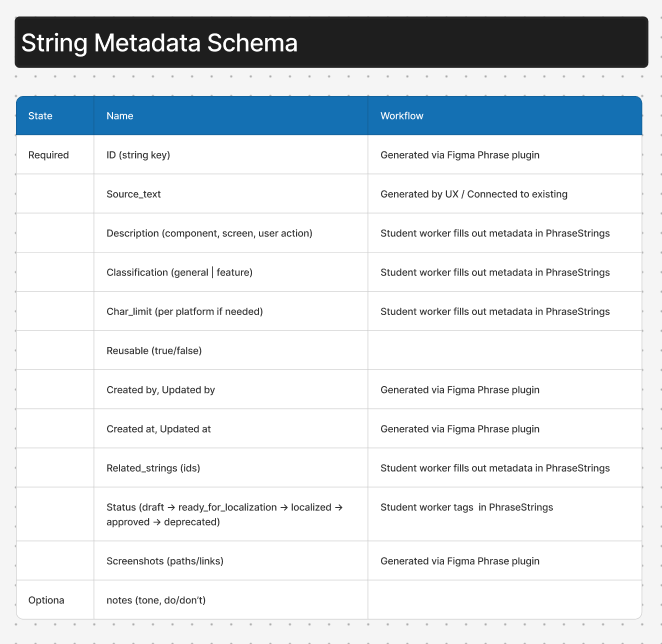
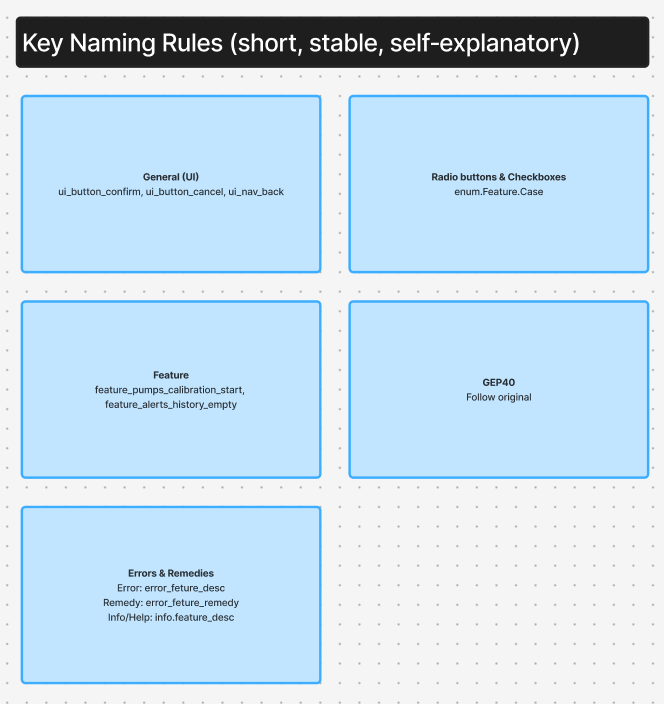
I engineered a master mapping matrix where every UI phrase is assigned a permanent, unique semantic key — the immutable source of truth for both Figma and the codebase. Coordinated with Global Product Marketing to populate translations in Phrase against these keys, so developers fetch localized content programmatically without manual copy-pasting or UI adjustments.
Process
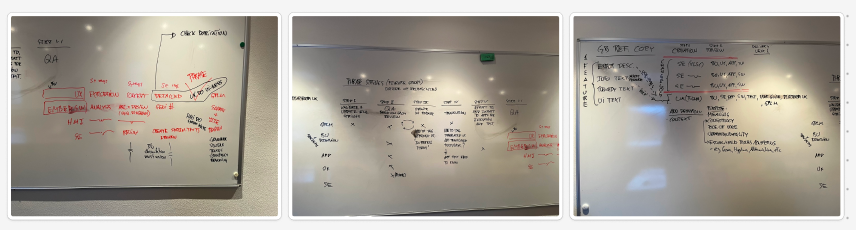
Artifacts from the room.

Outcome
Unified Global UX: Established a seamless, localized experience across 32 languages, completely eliminating visual fragmentation and text alignment errors across international markets.
Reduced UI maintenance costs by automating the translation pipeline via Phrase. It removed the need for manual design adjustments during localization updates, drastically reducing development handoff time and operational costs.
Preserved technical authority by the unique key mapping matrix. This ensured that high-precision industrial terminology — specific pump statuses and flow metrics — maintained accurate contextual meaning across all regions, protecting Grundfos’s brand authority.
Accelerated Time-to-Market: The modular contribution model allowed Global Product Marketing and translation teams to update copy independently, so localized software updates shipped without impacting core engineering cycles.
32
Languages supported through a centralized localization platform
Single
Source of truth for terminology across the global product suite
0
Manual string handoffs between design, translation, and development
Faster
Time-to-market for localized updates without engineering blockers
Next